
Spring: Awakening and New Growth
You don’t need to buy anything.
Just notice, breathe, and connect with the world already around you.
| The Gratitude Walk | Take a 15-minute walk. Don’t focus on distance. Simply notice five things you are grateful for in nature: the sound of frost underfoot, the shape of bare branches against the sky, the green of ivy, a bird song, the cold air filling your lungs. |
| Five Senses Sit-Spot | Find one spot in a park or garden. Sit for 5 minutes. Note one thing you can see, hear, smell, feel, and taste (like the air). This grounds you firmly in the present moment. |
| Dawn Chorus Moment | One morning, just open a window or step outside for two minutes. Cup your warm drink and just listen to the birds. Let that be your meditation for the day. |
SPRING TONICS
The term Spring tonic is a broad reaching term, which has many meanings and can be described in different ways. In basic terms it is a drink of herbal and/or newly emerging early Spring leafy green plants. This can be a simple tea of Dandelion to a more complex tonic wine. It is generally described as a drink which builds up your energy, flushes out your system, and is good for you.
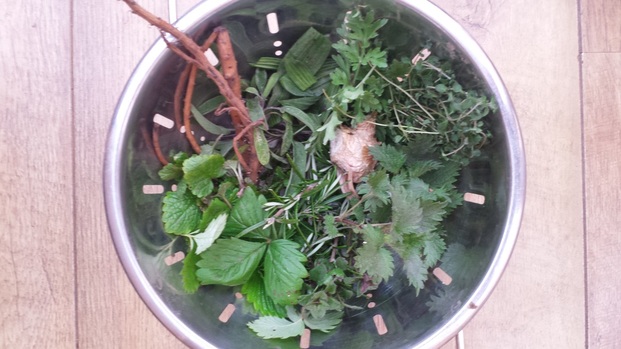
Matthew Wood, in the practice of traditional western medicine, describes It as a herb or food that acts on the body in a slow nutritive fashion to build up the substance of the body. Nettle is a good example of an all round good tonic as it contains many nutrients,vitamins, and minerals including Iron and Sillica.
Matt Wood also goes on to state how tonics can be split into groups in order to identify which would be best suited to an individuals needs – Bitter tonics were used to strengthen and nourish the liver and metabolism (alteratives,for the most part), Sweet tonics acted primarily on the immune system and adrenals (adaptogens).Oily tonics supplied fixed oils and essential fatty acids to tissues to ensure hydration, cell permeability, and to prevent atrophy. Mineral tonics provide essential minerals, and sour tonics are rich in bioflavonoids. Protein tonics are rich in protein.
HISTORY
In days gone by, no foods were imported, so people’s diets were quite limited; the meat people ate either had to be caught fresh or salted for preservation. Vegetables eaten through Winter would generally be root vegetables such as Potatoes, Turnip, Swede and some green leaves such as Cabbage and Kale. They would possibly have some left over grain, stored apples, and Fruit. Come Spring, people would have been malnourished and sluggish. Spring tonics formed an important part of restoring the strength and vitality necessary for the onset of hard work in the fields. People would choose plants growing in abundance locally to themselves. We live in a very different environment today with a completely different food system however today we have major problems concerning the poor quality of food available because of inefficient farming methods, pesticides and insecticides, bad animal practice/meat production and the rise of junk food and ready meals that the consideration of harvesting greens for Spring tonics I would suggest is as of much benefit today as they help to shift toxins in sluggish cells and introduce vitamins andminerals to revitalise.
NATURES SPRING TONICS
Matilda Peters Home Economics dept University of Nebraska–Lincoln
During my research i came across this report from 1926 which was interesting for a number of reasons, Matilda talks about how at that time people would take a Spring medicine treatment of Sulphur, molasses and Sassafras to hon the blood, she mentions how it was prevalent in drug stores a the time to sell such remedies and how it was her own feeling the it was not something we innately need. Indeed today in commercial terms the ‘detox’ is big business, it is inherent for humans to feel sluggish when coming out of Winter and indeed in today’s times i would argue it is more common for people to feel this throughout the year which is in the most part as Matilda quite rightly points out is that an adequate diet makes Spring medicines unnecessary.
Personally, however, I feel this depends on if getting an adequate diet at all times of year is possible, and suggest that Spring tonics are part of this, not separate as they can be made from the abundant plants around us. Interestingly, though during 1926 this may well have been possible as there were many modern farm homes well supplied with dairy, orchards, and gardens, they indeed did not have much difference between their Summer and Winter diets. This was due also to the practice of canning fruits and vegetables and modern transportation facilities. Matilda points out that where dietary practices are followed, there is then an absence of that tired feeling at the end of Winter. She also states that with the coming of warm weather, various greens became available and were eagerly consumed – Wild Onions, Sorrel, Dandelions, and Lambs quarters were promptly added to the food supply. Cows became fresh and milk was available; Hens added worms, insects, and tender grass to their diets, and so began laying eggs. The gardens would begin to provide fresh vegetables, and the first wild fruits of the season would be sought, and thus the tired feeling would disappear around that time. Matilda Peters’ advice is to eat raw and also practice canning and planning for the garden; they had what they called a fruit and vegetable budget, which was a plan for the proper amounts of fruits and vegetables to be grown, canned, and stored for use during the eight non growing months of the year in order to provide for the health of the family. As she also points out, it also avoids over canning one thin to ensure a pleasing variety over Winter! Of course we do have extended growing seasons today and seemingly at that point in history they possible did have less of a need for Spring tonics that previous generations needed and indeed possibly our society today needs today in our foodchain but the points about an adequate diet and for me along with appropriate available supplements from other plants throughout the year is the optimum goal for health and well being.
I like the idea of the fruit and vegetable budget, though, and think its an idea that could be revived and applied for today’s households, particularly in an urban setting looking to be more self-sufficient…..Permaculture your diet!!!!
PLANTS TO USE FOR A SPRING TONIC
There are a number of plants you can use but you must consider each one carefully remembering its effects vary depending on the individual as a general guide you can see below traditional uses for common plants:
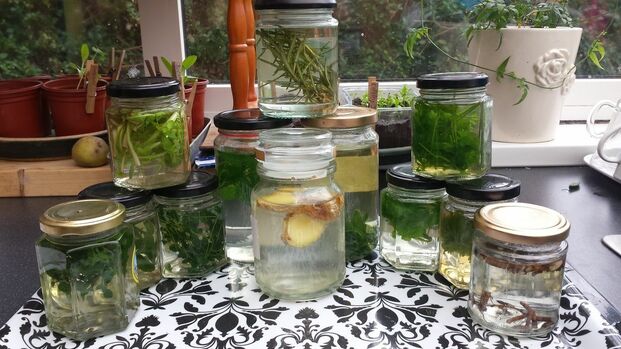
Cells – Burdock, Blood – Nettles, Ginger, Rosemary
Lymphatics – Cleavers,
Kidneys – Birch, Dandelion leaf, parsley or celery,
Liver – Dandelion root, Ginger, Milk Thistle, Turmeric
Bowel – Dock, Linseeds
Lungs – Ground ivy, Plantain, Thyme
Skin – Nettles, red clover, Burdock
There are many herbs and native plants that are of benefit as a spring tonic, Strawberry leaf was one i have never come across before which is high in vitamin C. I even came across mention of a lady in America whos neighbour had been using Violet leaves as a Spring Tonic. As part of my ongoing plant exploration, I have made up some Spring tonics being mindful of trying to use plants in abundance around me. I have also been having an experiment to make a herbal tonic that will be of particular benefit to myself. So I collected some plants from my garden which according to my research can be beneficial as Tonics- the plants i have been looking at are:
Dandelion leave and root – Diuretic, cholagogue, anti-rheumatic, laxative, Tonic The leaf is light and refreshing ( i used blanched leaves) it didn’t taste bitter and had almost a sweet tinge. The root had a mild earthy flavour not dissimilar to root vegetable cooking water.
Plantain – Expectorant, soothes inflamed and sore membranes, astringent This was rather bland tasting with no smell, it did have a pleasing bright yellow/green colour.
Wormwood – Bitter, tonic, carminative, anthelmintic, anti-inflammatory Wow! Pungent with a capital P! strong tasting and very drying on the mouth and tongue.
Rosemary – Circulatory, nervine stimulant, toning calming effect on digestion, muscular pain Pungent yet floral with a woody note, it felt warming and refreshing. Thyme – Bitter principle, carminative, anti-microbial, anti-spasmodic, expectorant, astringent, anthelminitic It had an earthy woody taste, like a basen flavour yet felt nourishing and refreshing.
Marjoram – Stimulant, expectorant, emmenagogue, rebefacient Also an earthy woody taste that yet refreshes
Nettle – Astringent, diuretic, tonic A green, light earthy taste feels uplifting and nourishing!
Sage – Carminative, spasmolytic, antiseptic, astringent, anti – hidrotic Very aromatic smell another woody one, it has a very plesent flavour not overpowering as i was expecting
Ginger – Stimulant, carminative, rubefacient, diaphoretic Strong, pungent spicy flavour warming on he tongue and stomach
Strawberry leaf – Diuretic, astringent, tonic, anti-bacterial, anti-fungal, anti-oxidant Mild taste, fresh put me in mind of Cleavers
Lemon balm – Carminative, anti-spasmodic, anti- depressive, diaphoretic, hypotensive Strong scent with a very strong lemon taste akin to Citronella.
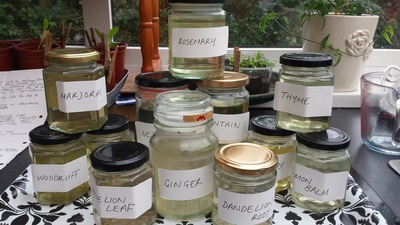
So i had a mix, a taste and a ponder and this is the one i came up with-
MY SPRING TONIC RECIPE
6 Nettle tops 3 sprigs of Thyme 3 Dandelion leaves 3 Strawberry leaves Small piece of Ginger Infuse in a cup of just boiled water for 10 minutes, strain and enjoy!
On the subject of also including looking at food as a String tonic I came across this recipe from 18th century France Pot herb pie – A Spring Tonic 1 pound of mixed greens(dandelions would be good, as well) 2 eggs 1 pint bechamel (white sauce) nutmeg salt and pepper lemon zest icing sugar and rose water–a sprinkle of each Remove stems from greens. Boil in salted water for 5 minutes. Drain, chop and squeeze dry. Make bechamel by stirring milk into a roux of butter and flour–grate in nutmeg and lemon zest. Simmer until thick. Beat eggs and stir in greens. Add to bechamel. Pour into pie shell of fine pastry. Sprinkle with a dusting of powdered sugar and a drizzle of rose water. Bake in a moderate oven. Remove from oven and allow to set for 10 minutes before slicing to serve.
Recipe adapted from A Taste of History, the Origins of Québec’s Gastronomy. Marc Lafrance & Yvon Desloges, Les Éditions de la Chenelière inc., Québec, 1989, p. 19
www.talesofakitchenherbwife.blogspot.co.uk
www.18thccuisine.blogspot.co.uk
Holistic Herbal by David Hoffman
 welcome
Leave a comment