
Beginnings….
In 2012, in response to an increasingly insane world, we created a permaculture community group to do something proactive in our community for health and well-being. We wanted to create local systems that support and develop practical resilience. Through this I met Annie who not only helped develop the group but also became a great friend, little did we know then about the journey with the nettle we were about to embark on.
We set a number of objectives – one of them looking at how we can provide staple crops for ourselves locally. These are, of course, a most important part of our diet as they are plant foods routinely consumed in large quantities, supplying a major portion of a population’s energy and nutrient needs. With our food systems being on a knife edge, we decided it was an important focus to look at what viable alternatives we could provide for ourselves.
So this is how our journey with the Nettles began…..Although perhaps not strictly speaking a staple crop in the traditional sense of the word it is a somewhat of a powerhouse!
One cup of blanched whole nettles contains:
- Calories: 37
- Protein: 2.4 grams
- Fat: 0.1 grams
- Carbohydrates: 6.7 grams
- Fibre: 6.1 grams
- Sugar: 0.2 grams
- Calcium: 428 milligrams
- Potassium: 297 milligrams
- Iron: 1.5 milligrams
Source: www.webmd.com/diet/health-benefits-nettle-leaf
But that is only the tip of the iceberg – or perhaps the tip of the nettle leaf to be more appropriate!
We have since learnt so much from many wonderful people about this amazing abundant natural resource and have held workshops, talks and even a few Nettlefests along the way! Most recently, I ran a Nettle immersion at The Theatre of small convenience in Malvern.
Back in 2020 the poem ‘The Nettle Epoch’ was born, the poem pays homage to the rich historical folklore and magick surrounding this plant but it also contains a lot of practical information about the nettle. Over the coming weeks I will be breaking it down to explain the factual meanings behind the metaphors and so, lets deep dive….
NETTLE EPOCH 20/20
News of the Nettle, A little bird brought me,
A message given to her whilst flying free,
Of how this year, if you get pierced – you will feel a sting oh so fierce!
Urere! Urere!…..To burn! To burn!
Bringer of the flame – A wisdom we call Nettlology,
A pioneer plant, which cannot be tamed.
A guardian of the threshold – transporter of the breath.
She is ready now for war – she is ready to protect,
Some say she is evasive, or is she screaming to be heard?
A NETTLE EPOCH!
Hear me cry!
Take heed of every word.

Firstly the title – An Epoch, a distinct period of time marked by notable events, new developments, or a significant shift in an era.
And so I declared that we have entered the nettle epoch! But Why?
Not only did I think this was appropriate because of what the nettle gives and teaches us but the timing just happened to coincide in a synchronistic way with the world descending into utter madness. Something I think the nettle can assist us to combat on many different levels.
The poem was written in 2020 but the number also plays on the phrase 20/20 vision – If you have 20/20 vision, it means you can clearly. In a metaphorical sense, Just as perfect vision lets you see clearly, “hindsight” (looking back in time) gives you perfect clarity on a situation where you might have made a bad call or been confused in the moment. This highlights what was revealed to us in 2020 for those who had the eyes to see. It also references what the nettle reveals to us if we are open to observe its nature.
In numerology, the sequence 20 20 (often seen as 2020) is a powerful symbol of spiritual awakening, divine guidance, and transformation. It is a reminder to trust your inner wisdom and have faith that your life path is unfolding exactly as it should. The sequence blends the energies of two highly spiritual digits:
- The Number 2: Represents intuition, cooperation, and the soul’s life purpose. It encourages deep introspection, balance, and trusting your inner voice over external influences.
- The Number 0: Symbolises the infinite, spiritual awareness, and the “God force”. It is a highly spiritual number that amplifies the energy of the numbers it appears with.
I had been trying to write a poem about nettles for many years, the practical information is of course paramount but a creative outlet to really embody a subject in a wholistic sense is very powerful. But, unfortunately there was no inspiration forthcoming. That was until a little bird brought me some news. That little bird being artisan soap maker and herbalist Katie Beswick of littlebirdsoaps.com who sent me a message saying she thought the nettles were stinging stronger than before this year, an interesting observation given the timing I thought.
Urere is a Latin verb meaning “to burn”. It is the root of Urtica, the botanical genus name for the Stinging Nettle plant and the medical term urticaria (hives/nettle rash). No further explanation needed there I think, Nettle can certainly bring the flame! I’m sure most of you have experienced it yourselves!

Nettlology was a term coined by my friend Lynda McFarlane of joiedevivreventures when many years ago she was the first person to believe in what I was doing enough to give me the opportunity to run my series of 6 nettle workshops for the first time covering nettles for the environment, as food, medicine and for body care. For fibre and also the rich folklore and mythology.
Pioneer plant species are the first organisms to colonise barren environments (like bare rock) or disrupted areas (like burned forests). They are hardy, fast-growing opportunists that survive on poor soil, break down rock into new soil, and add nutrients so other plants can eventually grow. These plants typically produce abundant, lightweight seeds easily dispersed by the wind, allowing them to rapidly exploit new gaps in the landscape. Again nettle is not strictly speaking a pioneer plant as it needs phosphorus and nitrogen in the soil to grow, but these are exactly the conditions that human settlements create and it will swiftly colonise an area particularly if it has been abandoned by humans. Stinging nettles are widely used by archaeologists, botanists, and historians as strong biological indicators of past human habitation. Their presence often marks the exact location of abandoned medieval villages, Roman outposts, old farmsteads, and ancient middens.
Stinging nettle is widely regarded in global folklore as a potent threshold guardian, serving as a magical bridge and protective barrier between the realms of life, death, and the unseen world.
https://www.mountainhedgewitch.com
- Warding the Home: Historically, bundles of dried nettles were hung over doorways or placed on windowsills to ward off evil spirits, sorcery, and negative energies.
- Life and Death: Nettles were frequently woven into ancient burial cloths, linking them to the ultimate threshold between life and death. In Celtic and Kawaiisu tribal traditions, the plant acts as a sentry against mischievous fairies and supernatural threats.
Transporter of the breath – How nettle affects oxygen in the body
- Oxygen Transport: Nettle is rich in iron, which helps the body produce hemoglobin. This boosts the blood’s capacity to carry oxygen to your muscles, brain, and organs, effectively fighting fatigue.
- Cellular Oxygenation: Herbalists often use nettle to support natural nitric oxide levels in the body. Nitric oxide acts as a vasodilator, meaning it relaxes blood vessels so that nutrient-rich oxygen reaches every part of your body more efficiently.
https://nettlerevolution.co.uk
In simple terms, Invasive means something that spreads where it doesn’t belong or enters in a way that causes harm or discomfort. Some may describe Nettle in this way but I suggest another way of looking at it is that when the conditions are right it allows what is needed at that particular time to thrive, therefore, observation and interpretation of these signs is imperative.
In the British Isles we have 3 nettle species
N.B Not to be confused with the Dead Nettle – Lamium Album
Urtica Urens – A small native annual Nettle which grows to 50cm high, it has male and female flowers on the same plant and the mildest sting.
Urtica Pilulifera – Also known as the Roman Nettle as that is its origin, an annual which grows 1 metre high. Its flowers grow in clusters with globular heads, it is mainly found by the sea but it is rare. This is the most venomous of the 3.
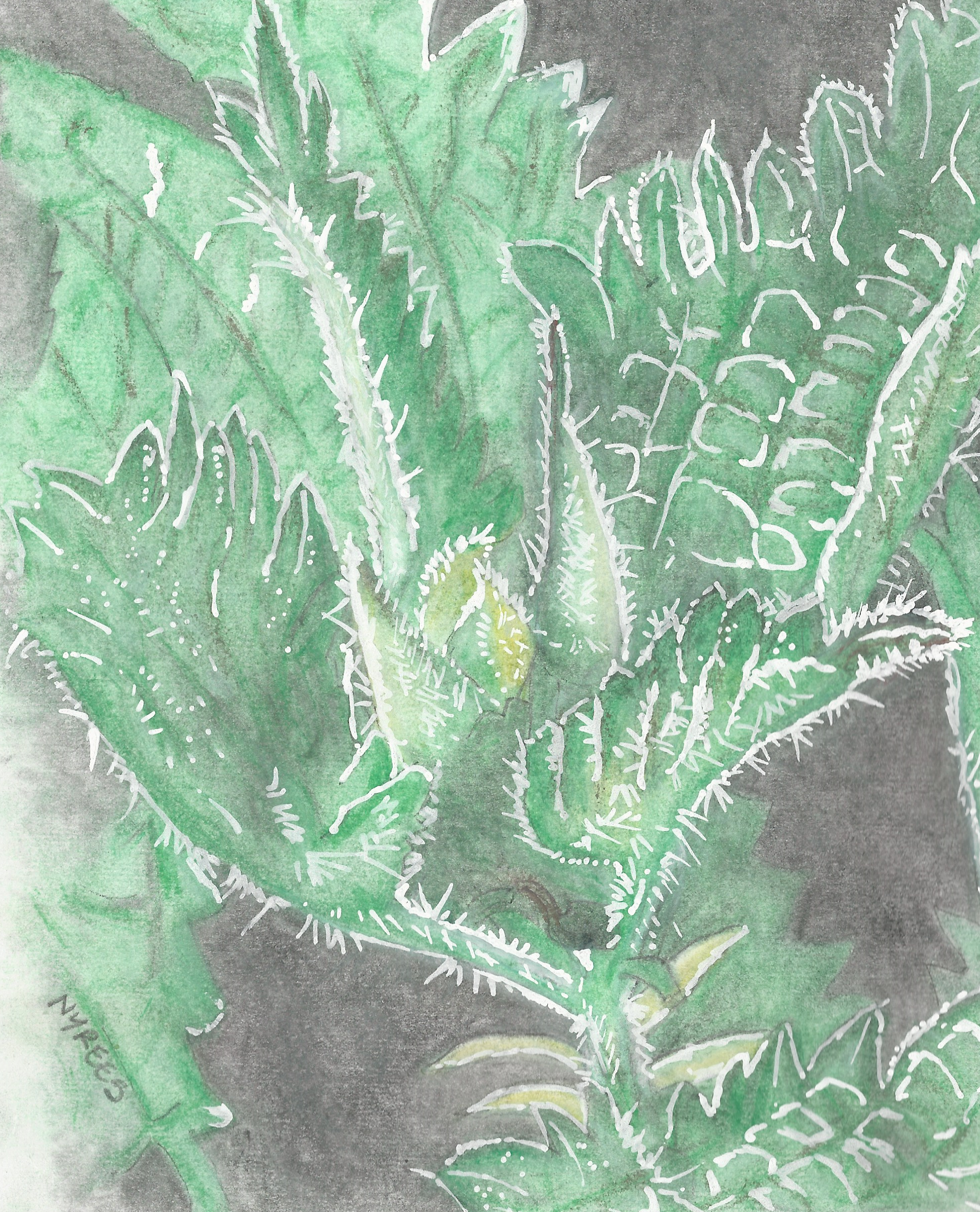
Urtica Dioica – A perennial native plant well distributed across the UK, in Spring and Summer it can grow up to heights of 1 metre or more. It has dark green heart shaped, serrated edged leave which are covered in stinging hairs as are the square(ish) stems.
Research indicates that in food and herbal terms most species of nettle are somewhat interchangeable.
This is just the beginning, and just a few of the reasons I felt compelled to cry out the declaration that we have entered the nettle epoch. As you can see we have a lot to unpack over the next few weeks, thanks Annie, Lynda and Katie without you my nettle journey would not have happened and the poem would not have been born. So listen closely, grasp the nettle and hang on to your (nettle) pants .
Look out for the next instalment coming soon.